

There is a common misconception in primary education that class sizes matter most during exam years — Year 6 or Year 11.
Child developmental science shows the exact opposite.
A fifteen-year-old has the executive functioning, reading ability, and self-direction to learn independently from a textbook even in a large lecture. A four-year-old does not. Between ages three and five, every cognitive milestone — speech clarity, emotional regulation, pencil grip, phonological awareness — depends on direct, responsive human interaction.
In Nairobi's Early Years Foundation Stage (EYFS) classrooms, attention is arithmetic before it is philosophy. Here is why class size ceilings determine everything during your child's first years of school.
1. The Three Prime Areas Depend on Responsive Adult Interaction
The British Early Years Foundation Stage framework is structured around seven areas of learning. Crucially, three of them are designated as Prime Areas:
- Communication and Language
- Physical Development
- Personal, Social and Emotional Development (PSED)
These are called "prime" because they form the biological and emotional foundation for everything that follows. A child who cannot articulate frustration will act it out physically. A child who cannot hold focus during a three-minute conversation cannot access reading instruction, no matter how bright they are.
Language development in young children does not occur through overhearing speech; it occurs through "conversational turns" — rapid, back-and-forth verbal exchanges where an adult listens, interprets, expands, and reflects the child's thought back to them.
In a nursery or reception classroom with thirty children, conversational turns are rationed by sheer math. Teachers are forced into crowd management. In a classroom with a strict cap of twenty-five and dedicated early years educators, every child has daily, unhurried conversations that expand vocabulary and nurture emotional security.
2. Systematic Phonics: Caught Early or Missed Entirely
The British National Curriculum teaches early literacy through systematic synthetic phonics. Sounds (phonemes) are taught in a deliberate, evidence-based sequence, which children learn to blend into words.
Phonics is rigorous, effective, and unforgiving of inattention. If a four-year-old confuses the sound /s/ with /c/ or struggles to blend three individual sounds (/c/-/a/-/t/ into "cat"), that gap must be spotted in the very session it occurs.
Left unspotted for three weeks, reading transitions from an exciting discovery into a source of anxiety. In a small, capped class, an educator hears every child articulate their sounds every single day. Difficulties are corrected gently in the moment, before they become entrenched learning blocks.
3. Emotional Regulation and the Transition from Home
For many children, joining EYFS (Nursery or Reception) represents their first prolonged separation from home and parents.
The neurological priority for a young child in a new environment is felt safety. Until a child feels psychologically safe, the brain's amygdala remains activated, and higher-order learning in literacy and numeracy is biologically blocked.
Establishing felt safety requires attuned adults who notice subtle cues: the child who retreats quietly to the reading corner, the child who becomes hyperactive when overwhelmed by noise, the child who needs an extra hand during morning drop-off.
Large classrooms overwhelm sensitive children and mask quiet distress. A capped setting provides the calm, predictable rhythm children need to settle, make friends, and build trust in their teachers.
4. Physical Play and Fine Motor Mastery
In our digital age, children increasingly arrive at preschool with underdeveloped hand strength and core stability.
Learning to write is not a cognitive task; it is a physical one. It requires shoulder stability, wrist control, and pincer grip strength developed through climbing, balancing, moulding clay, cutting, and handling real tools.
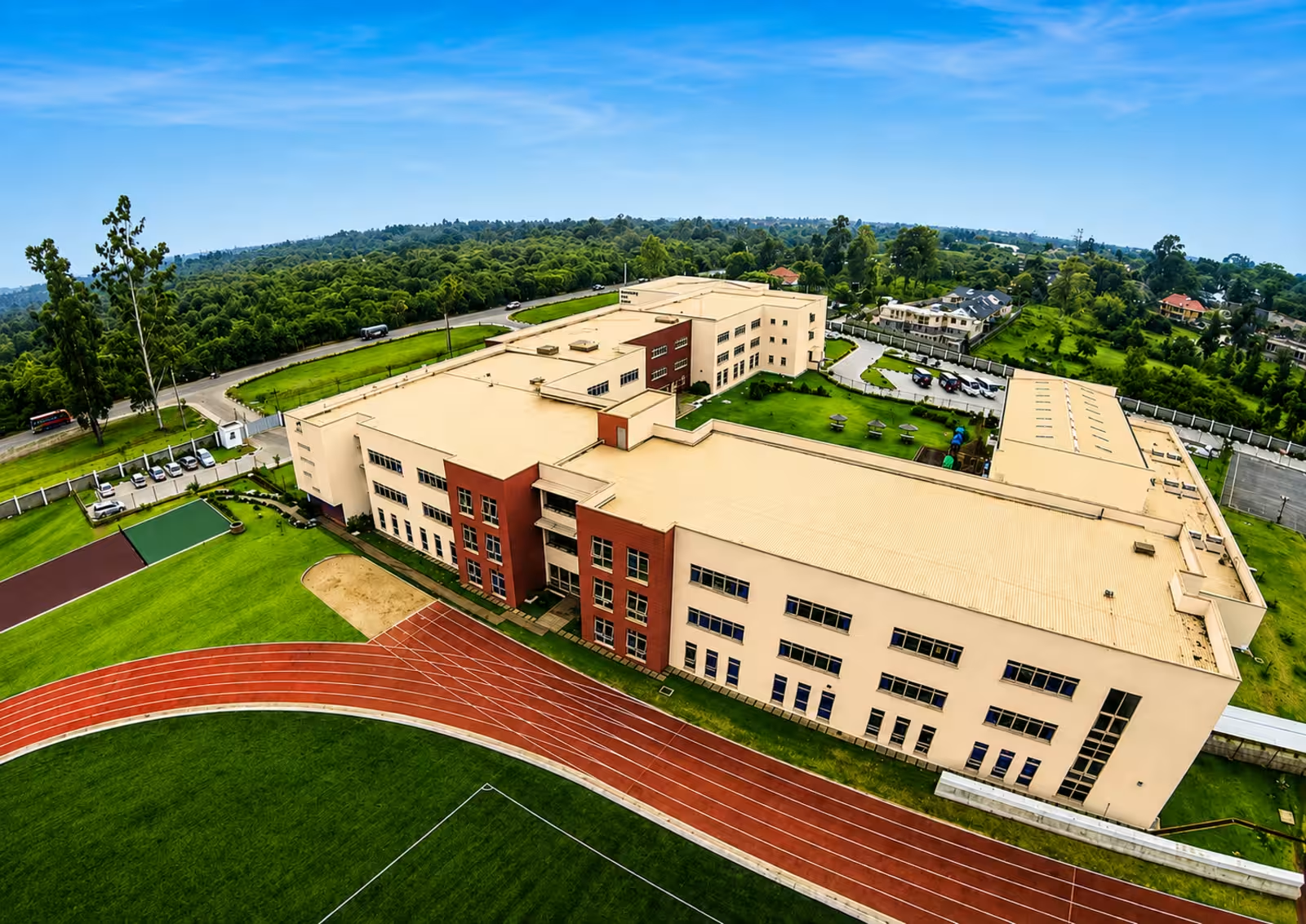
Karen provides an extraordinary natural advantage here. At Elyton, our Early Years pupils have dedicated outdoor learning spaces alongside access to our playing fields and track. Space to dig, balance, and run builds the gross motor foundations that make sitting comfortably and writing with a pencil effortless by Year 1.
What to Look for When Touring an EYFS Classroom
When you visit a preschool or nursery in Karen, look past the decorative wall displays and observe the human dynamics:
- Listen to the noise level: Is it chaotic shouting, or the engaged, purposeful hum of busy children?
- Watch the adults: Are teachers sitting on the floor at eye level with the children, or standing above them directing group movements?
- Ask the hard question: "What is the absolute maximum number of children who will be in this room on any given day?"
At Elyton International School, our early years classrooms on Magadi Road are capped at twenty-five, led by early childhood specialists who understand that these early years can never be repeated.
Come and observe our early years environment in person. Book a private weekday tour and see how we welcome our founding cohort.